H2O2
Pure 100% peroxide is rarely used in rocketry due to its extreme sensitivity. Most “high-end” systems (like the Black Arrow or X-15) used 85% to 95%.
Critical Risk Thresholds
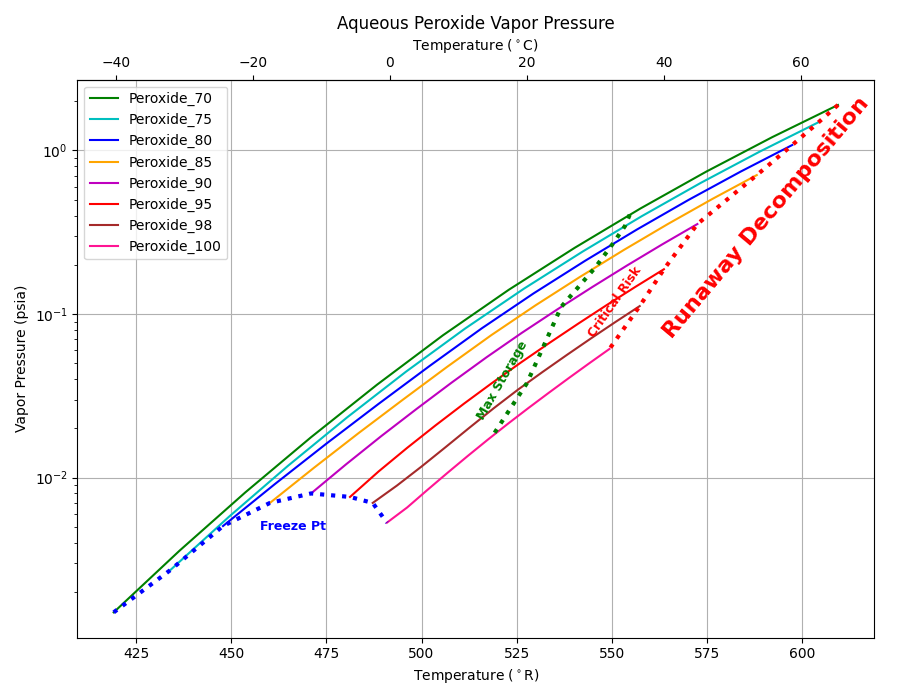
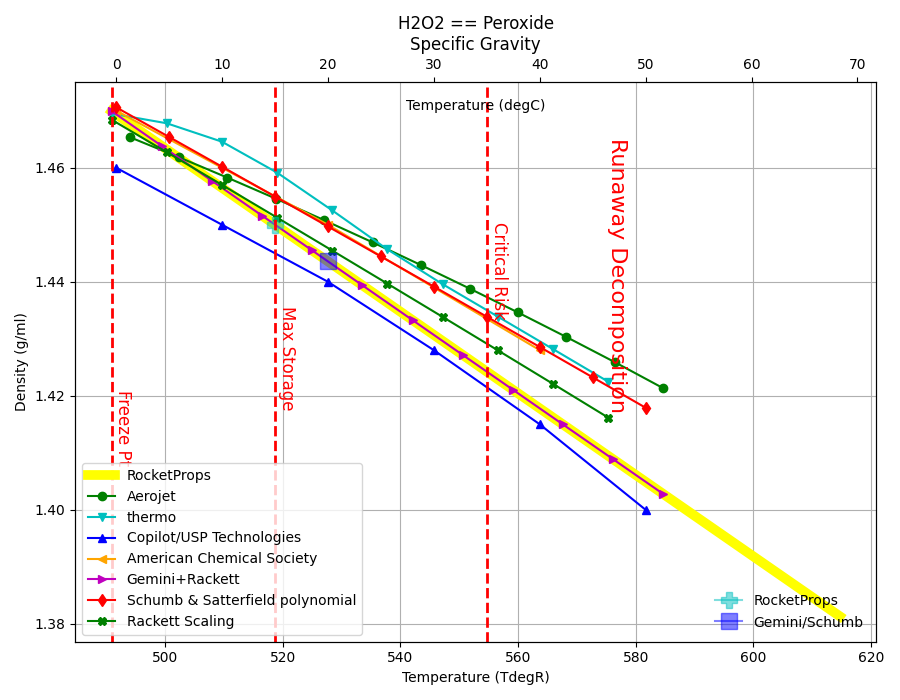
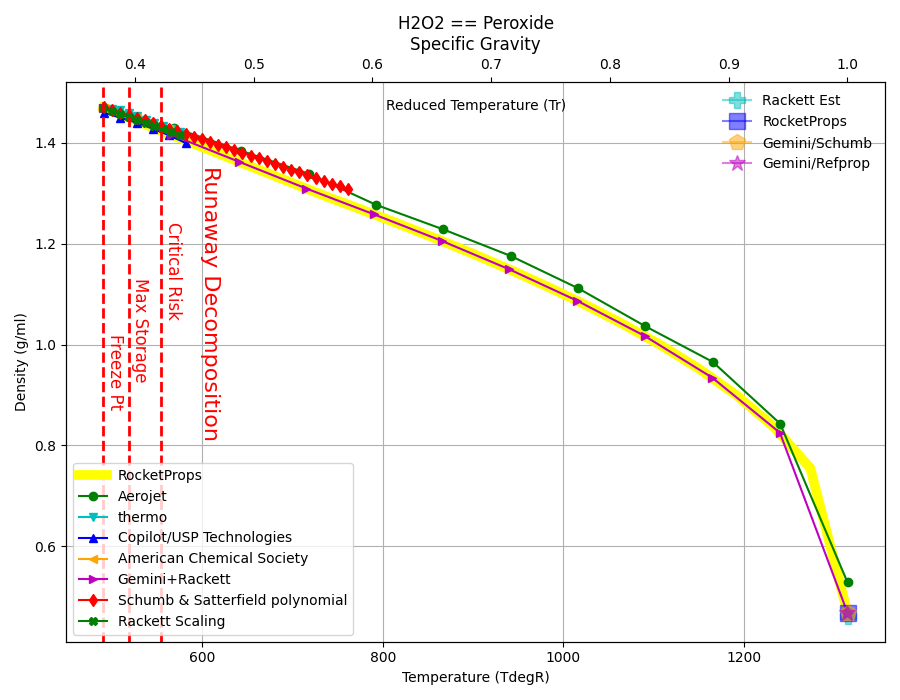
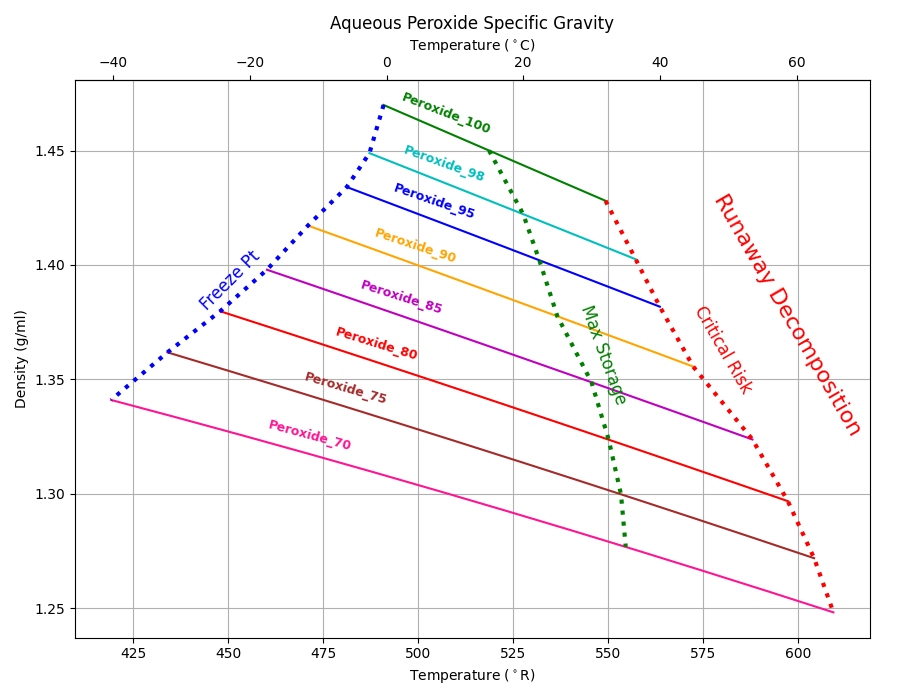
There is a “Red Line” temperature for storing high-concentration HTP. Beyond this point, the rate of decomposition increases exponentially, often exceeding the ability of the liquid to shed heat to the environment. This leads to Thermal Runaway.
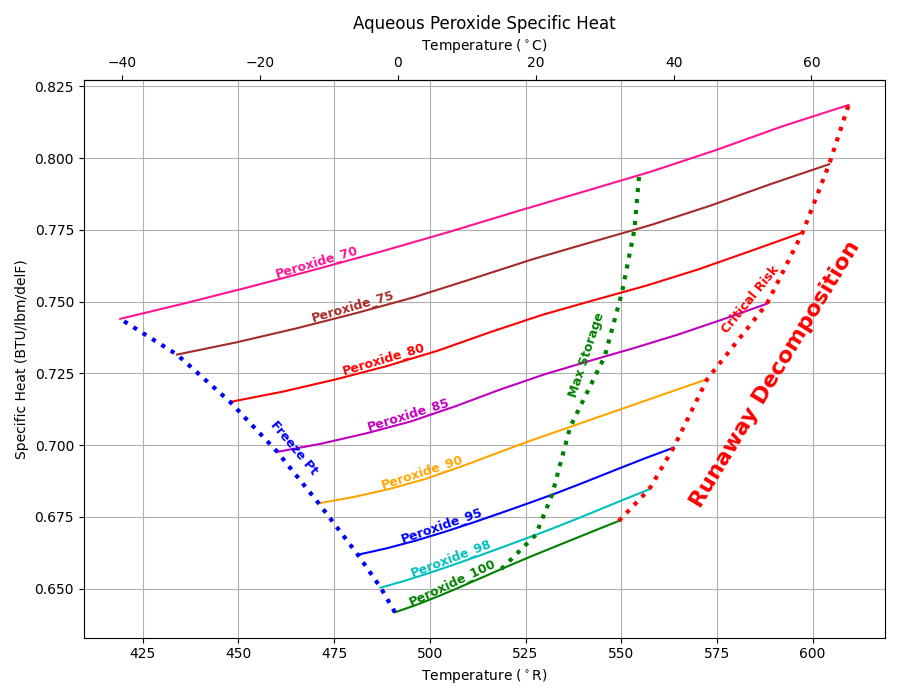
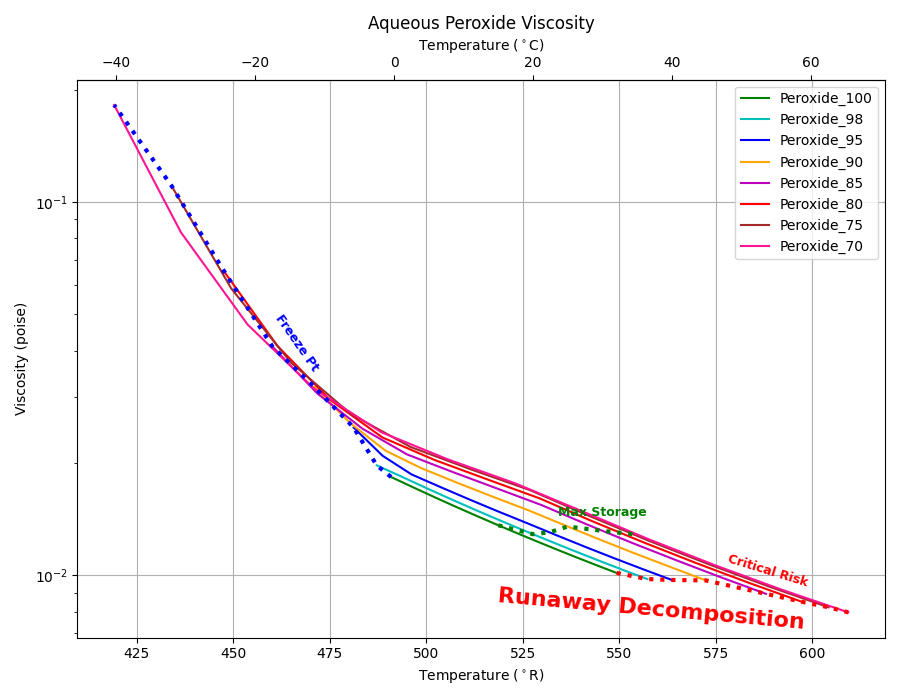
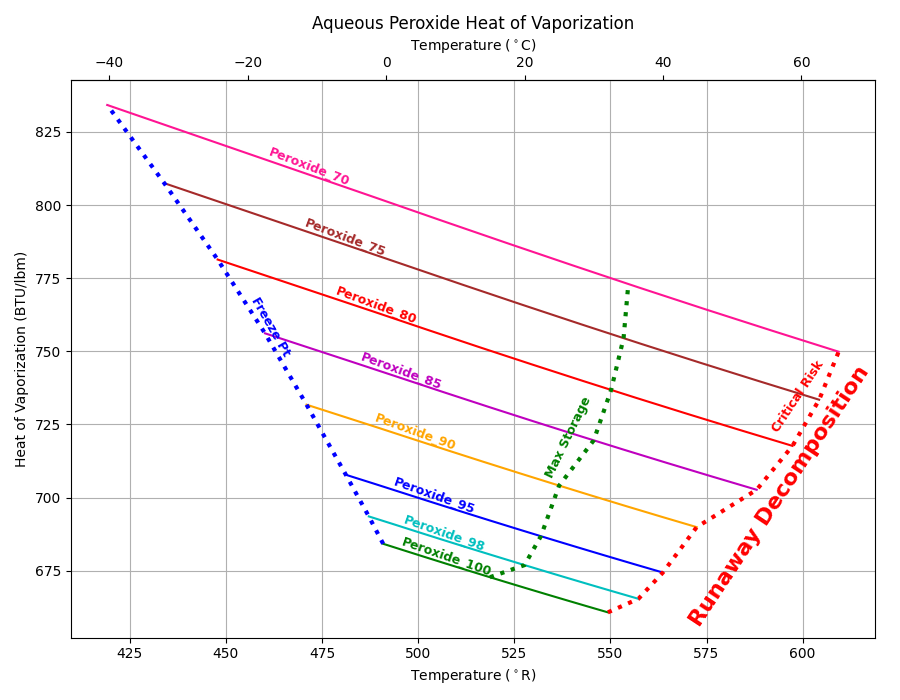
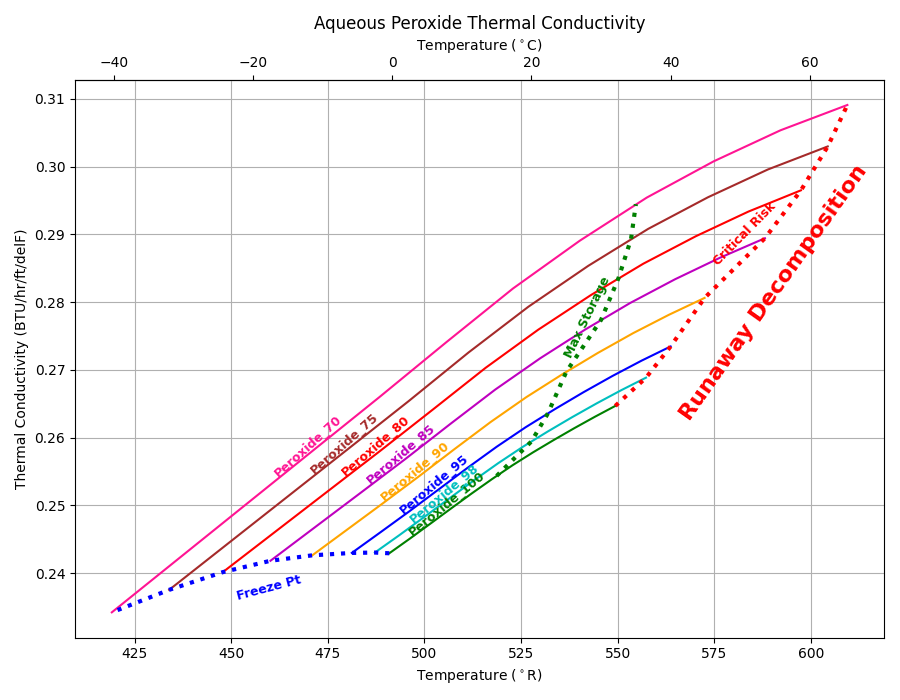
The chart below illustrates the temperature range at which aqueous mixtures of peroxide can be used.
In that chart, the curve marked “Critical Risk” is considered a Tactical Emergency. If your tank sensors hit these numbers, the standard procedure (per AFRPL-TR-67-144) is usually to dump the propellant or initiate a “water deluge” to drown the reaction.
Contact with metals, dirt, or organic materials can trigger violent, immediate decomposition.
NOTE:
3% to 70%: Assumes standard industrial stabilizers. These allow for storage at 25°C–35°C with only minor venting.
85% to 90% (HTP): Specifically assumes the “Propellant Grade” (MIL-P-16005) stabilizers. Without these, even trace amounts of aluminum, iron, or copper from the tank walls would trigger a decomposition chain well below 50°C.
100% (Anhydrous) \(\text{H}_2\text{O}_2\) : Schumb and Satterfield noted that truly anhydrous, unstabilized peroxide is so sensitive that it can decompose from light exposure or the roughness of a glass surface at room temperature (20∘C).
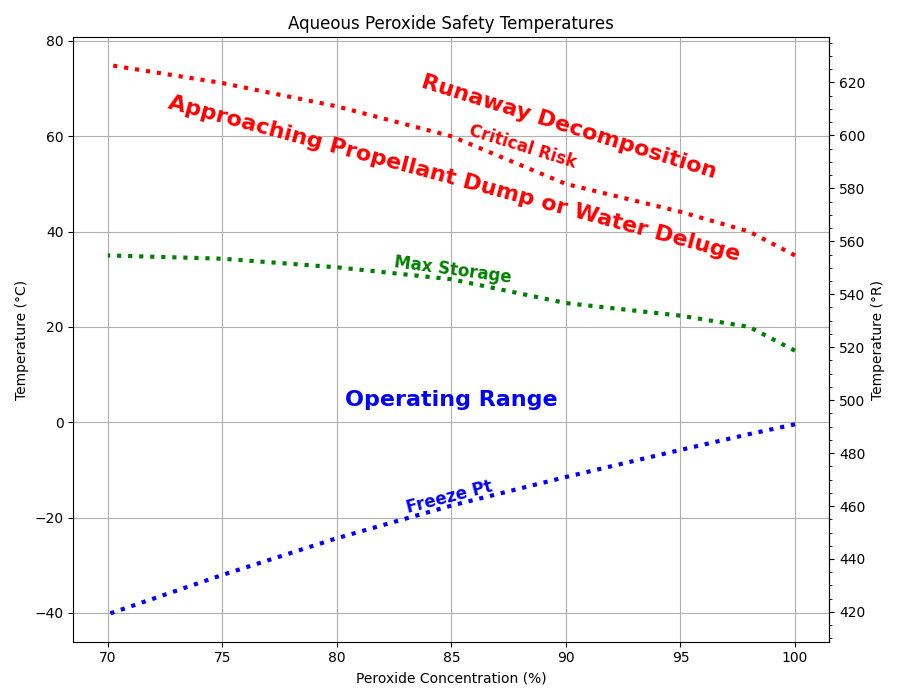
Click Image to View Fill Size
SAFETY LIMITATION: Consistent with Schumb et al. (1955) and AFRPL-TR-67-144, properties near the critical point are extrapolated. \(\text{H}_2\text{O}_2\) is inherently unstable at these elevated temperatures; the presence of even trace contaminants will trigger instantaneous “runaway” decomposition.
Reference Points
H2O2 == Peroxide
Hover over column headers to see definitions, values to see alternate units
| Tref | Pref | SG | Cp | dHvap | Visc | Cond | Surf | |
|---|---|---|---|---|---|---|---|---|
| Source | R | psia | g/ml | BTU/lbm-R | BTU/lbm | poise | BTU/hr-ft-R | lbf/in |
| RocketProps | 518.7 | 0.0 | 1.4500 | 0.657 | 672.8 | 1.363e-02 | 0.2544 | 4.646e-04 |
| CRC_ChemPhysHandbook | 536.7 | 14.7 | 1.4400 | --- | 652.2 | --- | --- | --- |
| Gemini/Schumb | 527.7 | 0.0 | 1.4436 | 0.662 | 669.2 | 1.246e-02 | 0.2577 | 4.585e-04 |
| Aerojet | 527.7 | 14.7 | 1.4505 | 0.634 | 596.0 | 1.013e-02 | 0.2782 | --- |
Fluid Properties
H2O2 == Peroxide
Hover over column headers to see definitions, values to see alternate units
| MolWt | Tc | Pc | SGc | Zc | Tnbp | Tmelt | omega | |
|---|---|---|---|---|---|---|---|---|
| Source | g/gmole | R | psia | g/ml | (-) | R | R | (-) |
| RocketProps | 34.015 | 1314.4 | 3144.4 | 0.4680 | 0.2596 | 762.0 | 490.9 | 0.38954 |
| CRC_ChemPhysHandbook | 34.015 | 1310.4 | 3190.8 | --- | --- | 762.1 | 490.9 | --- |
| Gemini/Refprop | 34.015 | 1314.3 | 3144.4 | 0.4680 | 0.2596 | 762.1 | 490.9 | 0.59100 |
| Gemini/Schumb | 34.015 | 1314.4 | 3144.4 | 0.4680 | 0.2596 | 762.0 | 490.9 | 0.38954 |
| Aerojet | 34.016 | 1314.7 | 3146.0 | 0.4612 | 0.2635 | 762.1 | 490.9 | 0.32031 |
Vapor Pressure
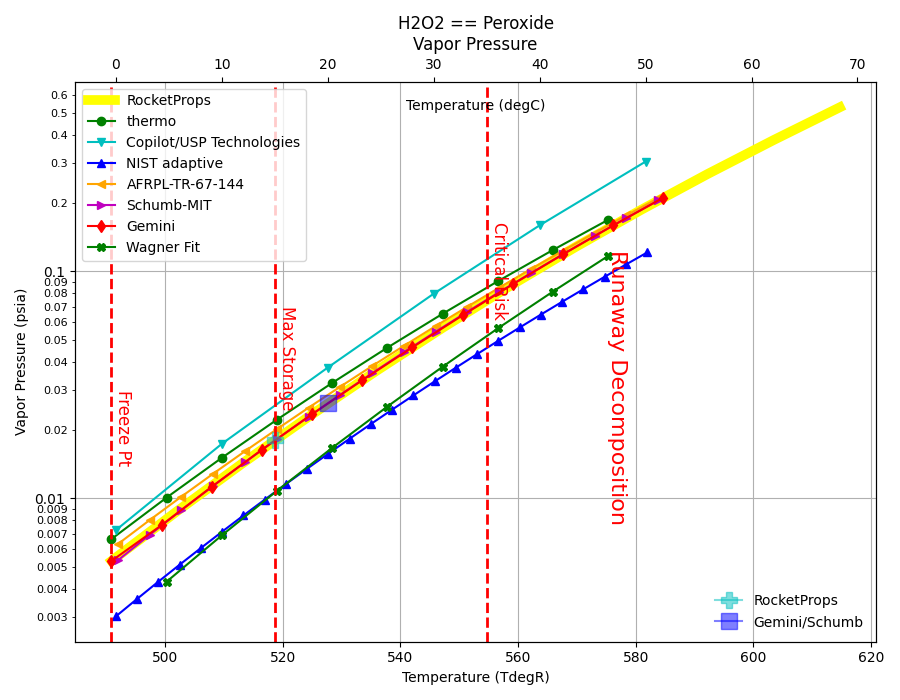
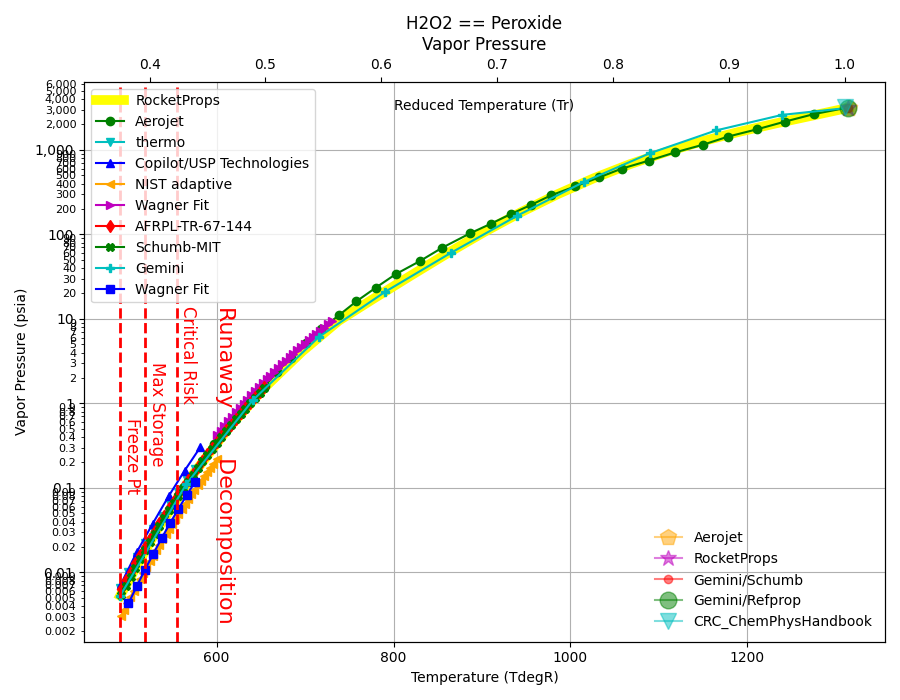
Click Image to View Fill Size
Density
Click Image to View Fill Size
Heat Capacity
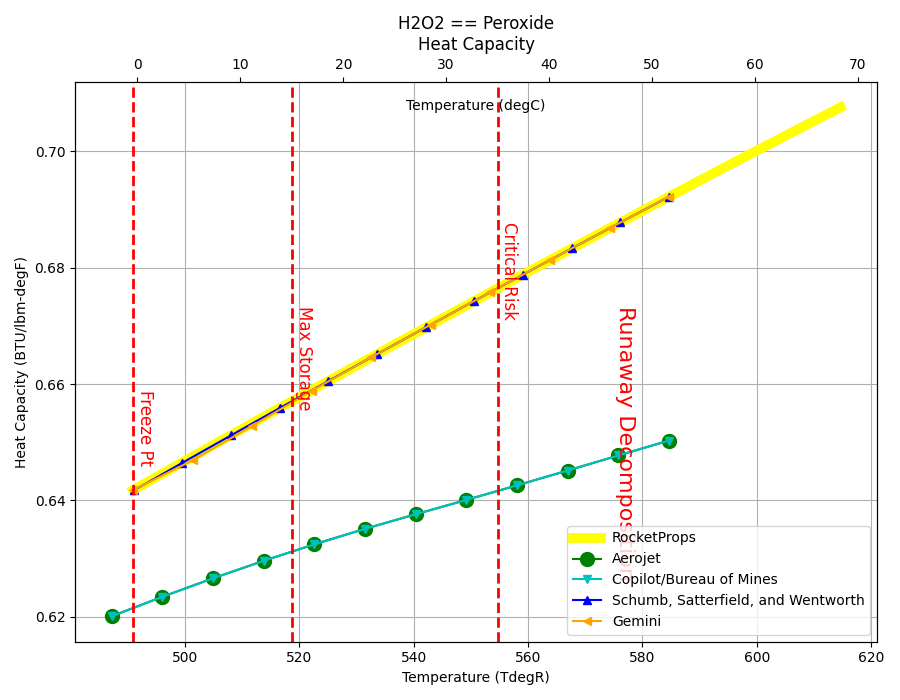
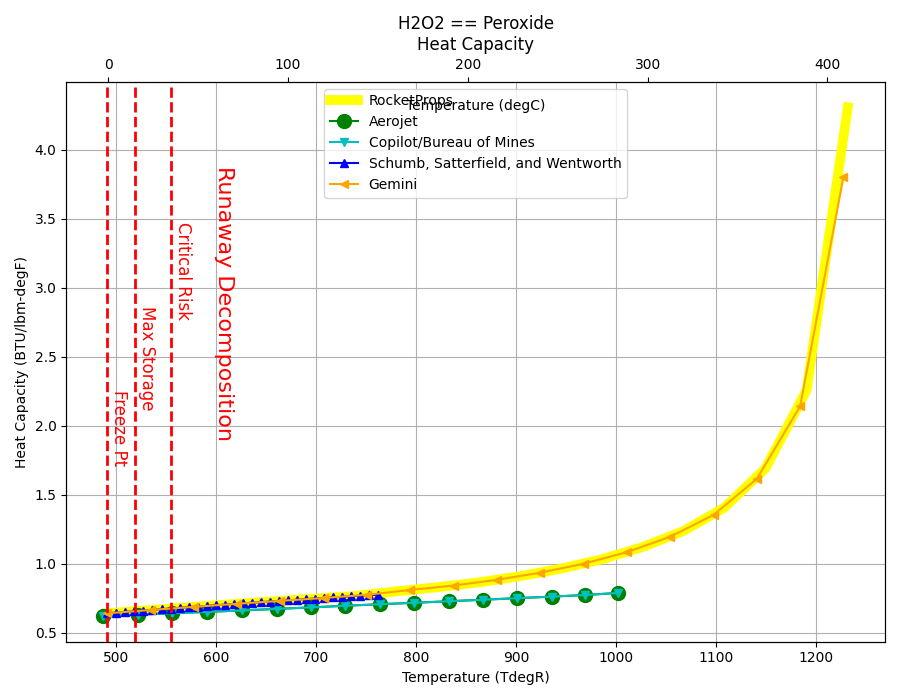
Click Image to View Fill Size
Viscosity
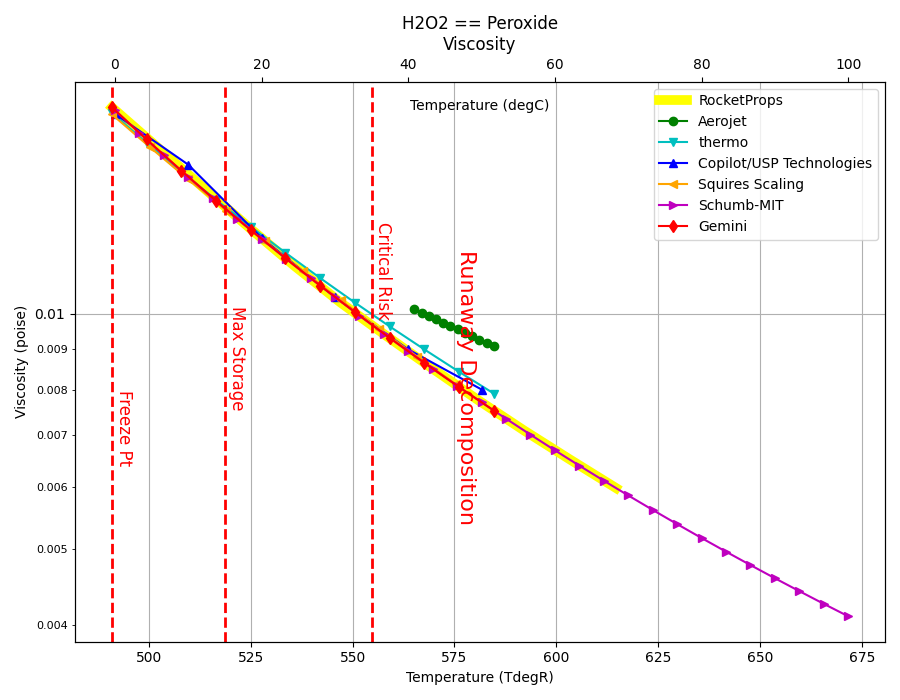
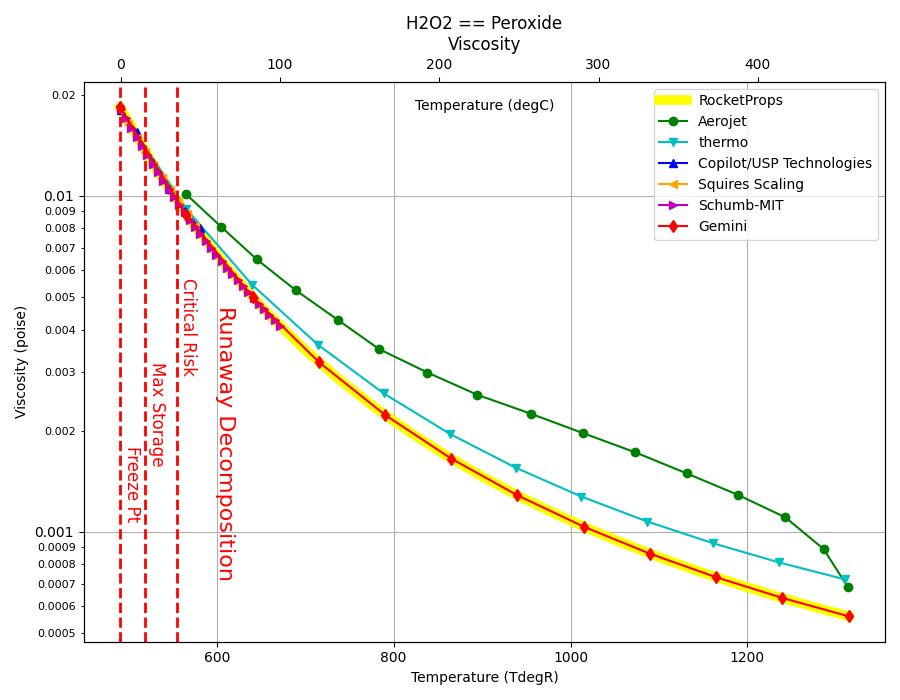
Click Image to View Fill Size
Heat of Vaporization
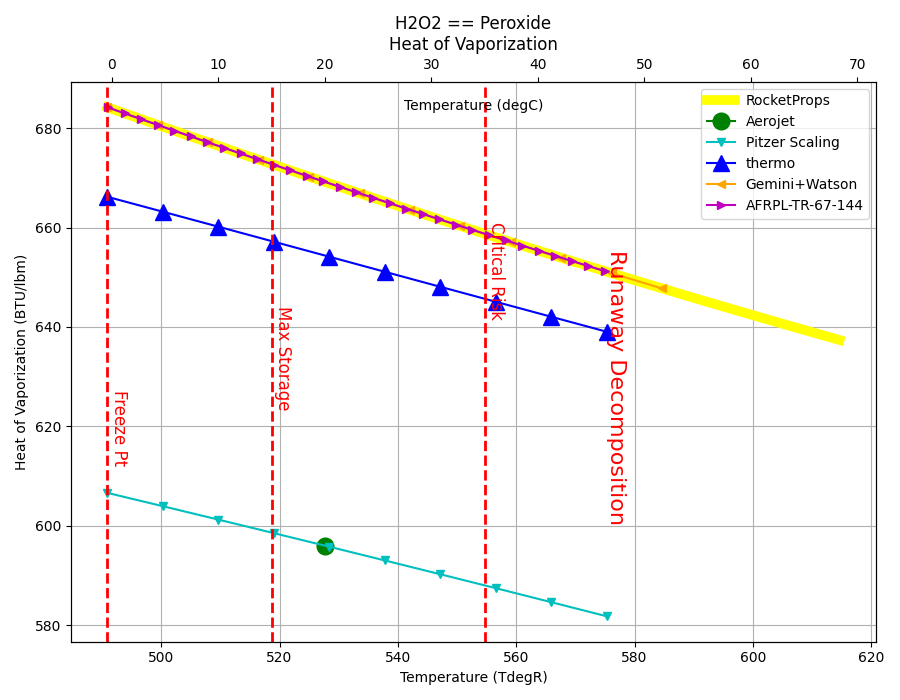
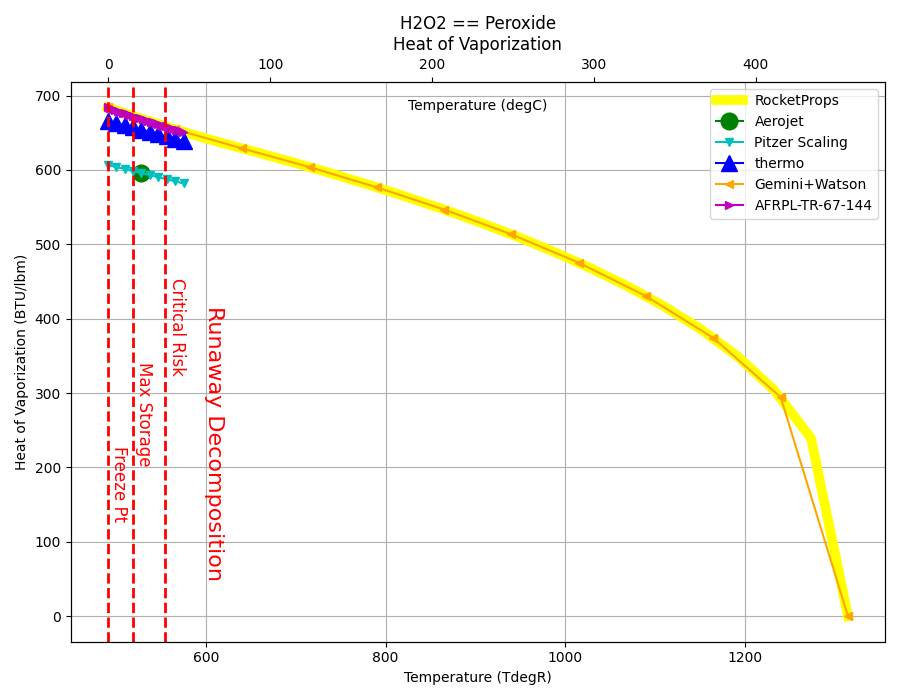
Click Image to View Fill Size
Thermal Conductivity
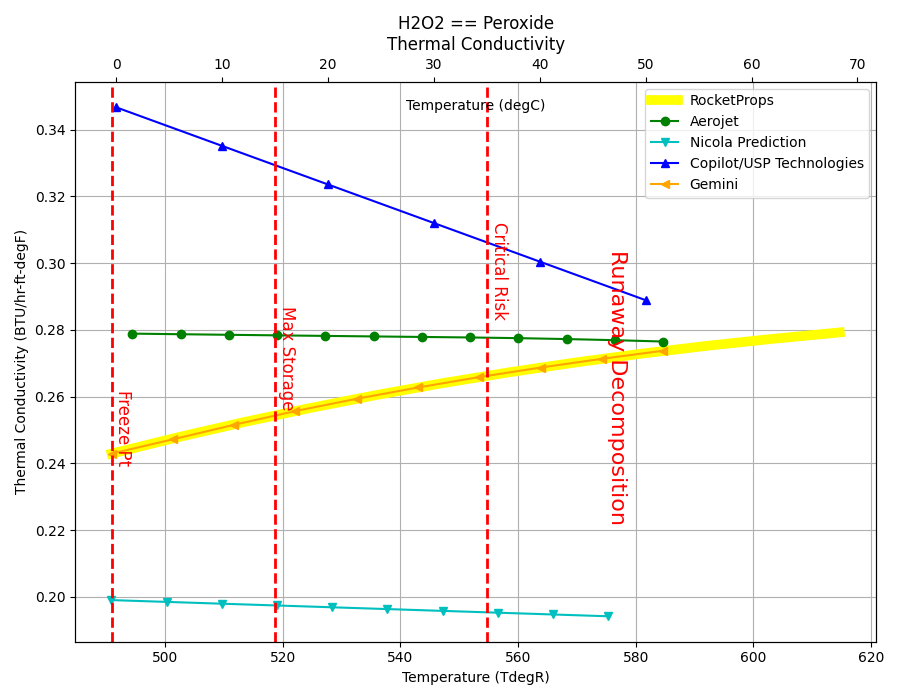
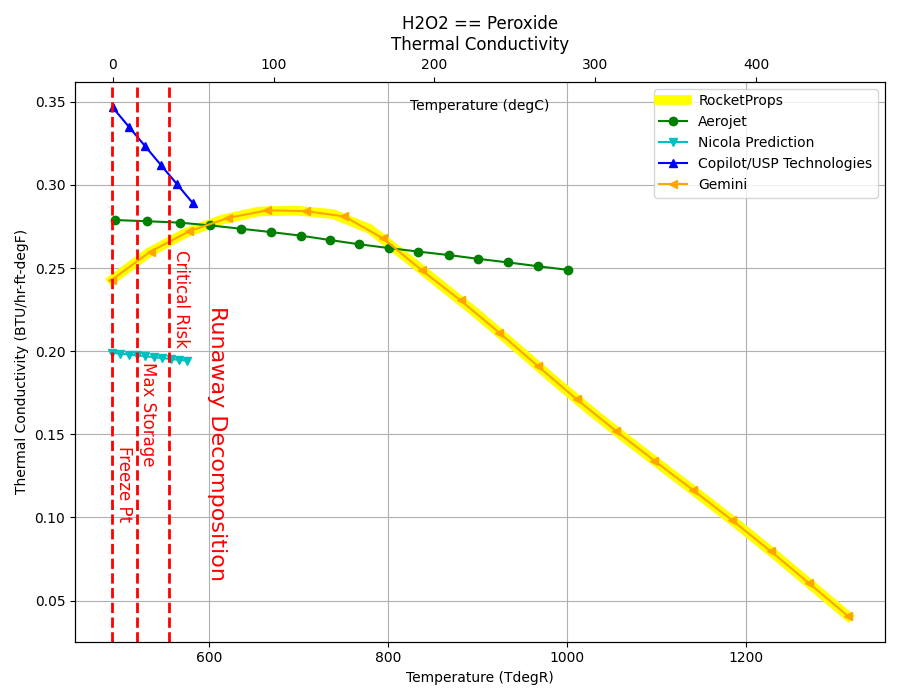
Click Image to View Fill Size
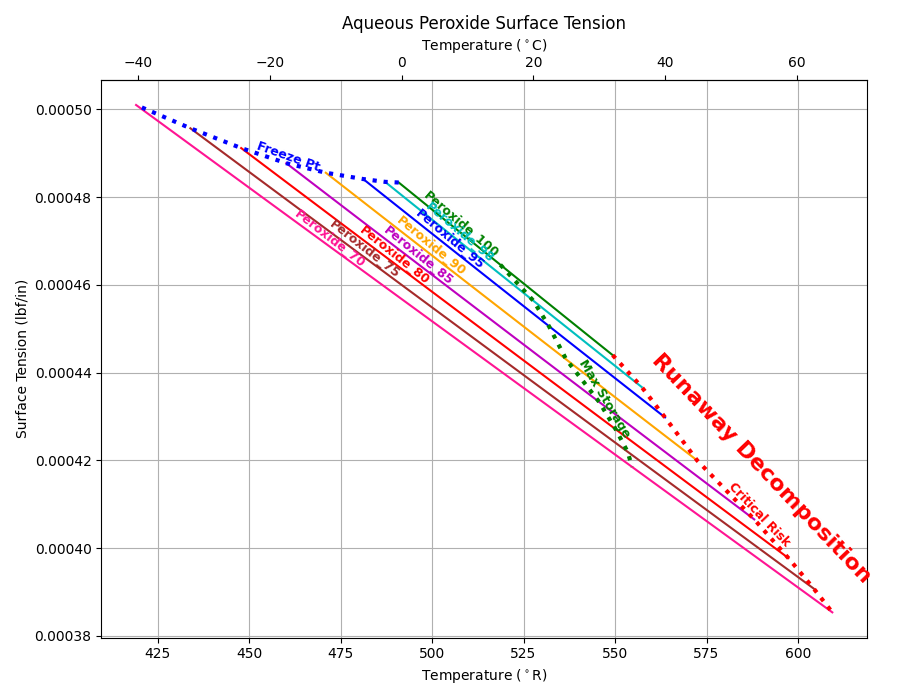
Surface Tension
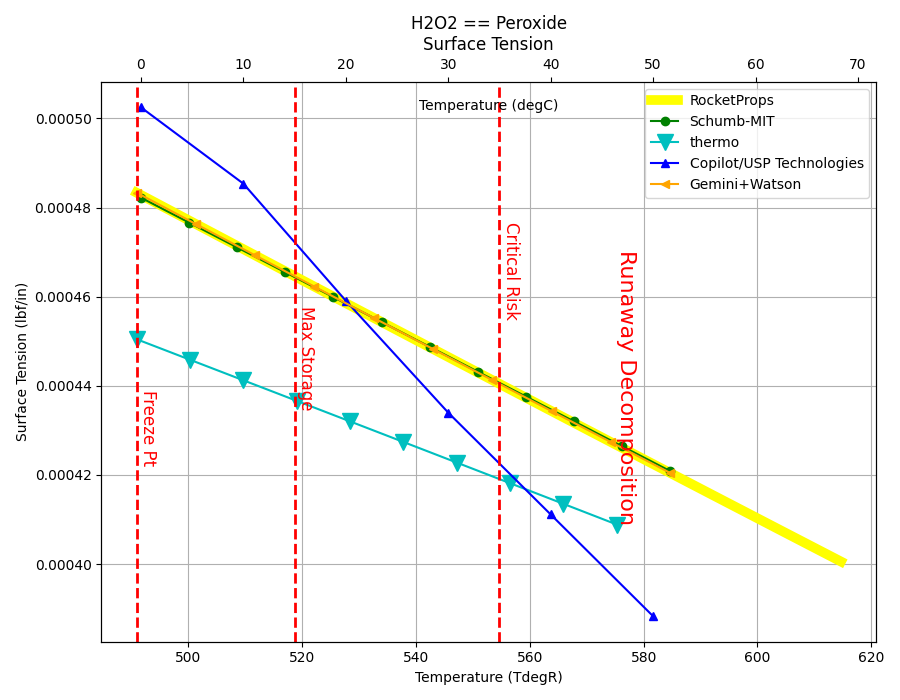
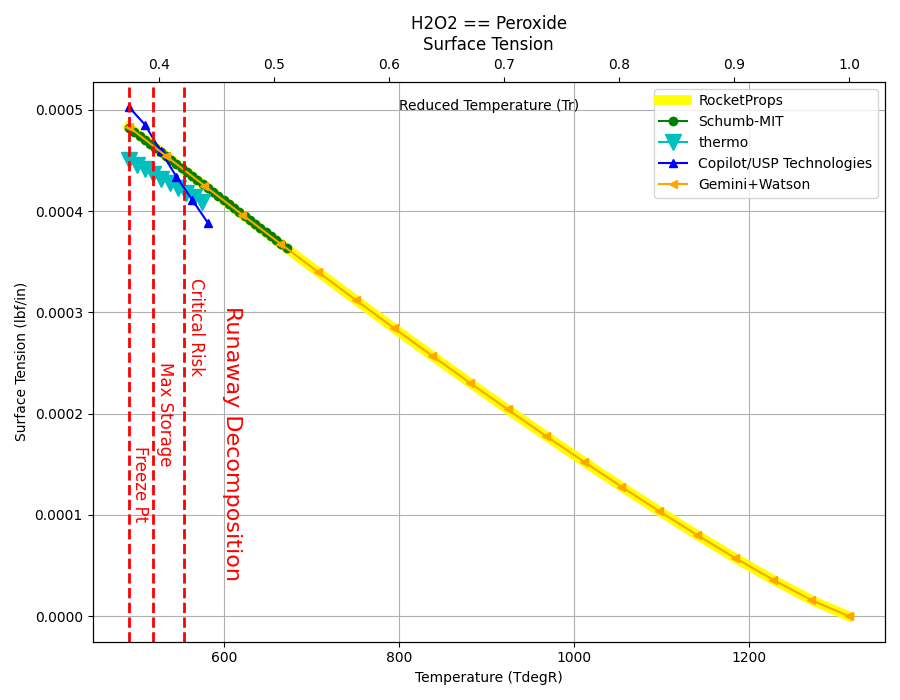
Click Image to View Fill Size